What Are Forex Signals?
Learn what trading signals are, how they work, and their benefits. Discover expert-backed forex and crypto alerts to trade smarter with The Signal Service.
Professional Forex Signals Based on Elliott Wave Analysis
Forex signals are essentially trading alerts or recommendations for currency pairs, suggesting when to enter (buy/sell) and exit trades at specific price levels. In practice, a signal may tell you something like “Buy EUR/USD at 1.1050.” Signals can be generated by experienced human analysts or automated algorithms, and delivered in real-time via email, SMS, or platforms like Telegram. The goal is to help traders – especially those still learning or short on time – by flagging potential opportunities without having to analyze the markets entirely on their own. For beginner and intermediate traders, signals can serve as both a learning tool and a second opinion on trade ideas. However, as we’ll explore, not all forex signals are created equal. A risk-first mindset is crucial – rather than seeing signals as guaranteed tickets to profit, you should view them as structured trade ideas that still require prudent risk management and understanding.
Why Most Forex Signals Fail – Common Pitfalls to Avoid
Forex signals can sound like a shortcut to easy money, but the harsh truth is most signal services fail to deliver lasting results. If you’ve tried signals before and ended up losing money or confidence, you’re not alone. Let’s break down the common pitfalls that cause many forex signals to flop:
No Risk Management – Perhaps the biggest red flag is a signal that doesn’t address risk. Even a great trade idea can turn into a big loss without clear risk controls. Many failing signal services simply broadcast entries without context, structure, or ongoing management. While some providers rely on fixed stop-losses, take-profit targets, and generic risk suggestions, these static parameters often fail to reflect how real market conditions evolve after entry.
The Signal Service takes a different approach. Trades are actively managed, with positions continuously monitored and decisions adjusted in real time as market structure develops. Rather than leaving traders exposed or guessing, risk is controlled through defined position sizing guidelines and live trade oversight — ensuring exposure remains disciplined even without mechanical exits.
When trades are managed properly, risk is not abandoned; it is handled dynamically. This replaces rigid, one-size-fits-all levels with informed decision-making, allowing trades to be exited early when conditions change or held when structure remains valid — a level of management that static signals simply cannot provide.
Overhyped Claims and Unrealistic Expectations – Be cautious of services that promise the moon: “Guaranteed 1000 pips a week! 90% win rate!” These marketing gimmicks prey on excitement but rarely pan out. In reality, no one can guarantee such returns, and every strategy has losses. If it sounds too good to be true, it is. Unrealistic profit claims and boasts of near-perfect accuracy are telltale signs of a signal seller more focused on hype than on sustainable trading. Traders who get lured by this often over-leverage and blow up when those lofty promises don’t materialize.
Overtrading or Inconsistent Delivery – Some providers flood you with signals all day, every day. Others go silent for weeks. Both extremes are problematic. Too many signals encourage overtrading, leading to impulsive, emotional decisions and high transaction costs. On the flip side, if signals are too infrequent or erratic, you might miss good opportunities or doubt the strategy. A quality service aims for high-probability setups, not just quantity. Consistency and selectivity indicate the provider is sticking to a strategy rather than chasing every random move.
No Risk-First Mentality – Ultimately, many signal services fail because they focus only on profits, not on protecting the trader’s account. They might not advise how to size positions, when to stay out of choppy markets, or how to handle losing streaks. This profit-only mindset can be ruinous. Without a risk-first approach, even a few bad trades can spiral into large drawdowns.
Bottom line: Most forex signals fail not because the idea of signals is bad, but because of poor design and poor discipline – no verification, no risk control, and too much hype. As a trader, being aware of these pitfalls helps you filter out the noise. In the next sections, we’ll show how our approach tackles these issues head-on by bringing structure, strategy and risk management to the forefront.
Elliott Wave-Based Methodology – A Unique, Structured Approach
So, how is our forex signal service different? In a word: structure. We don’t fling out random “buy now” tips or chase every spike on the chart. Instead, every signal is grounded in a robust methodology – specifically, an Elliott Wave based analysis combined with multi-timeframe confirmation and strict position sizing rules. This gives our signals a coherent framework and a risk-conscious game plan from the start.
Pattern Structure: Trading with Elliott Wave Principles
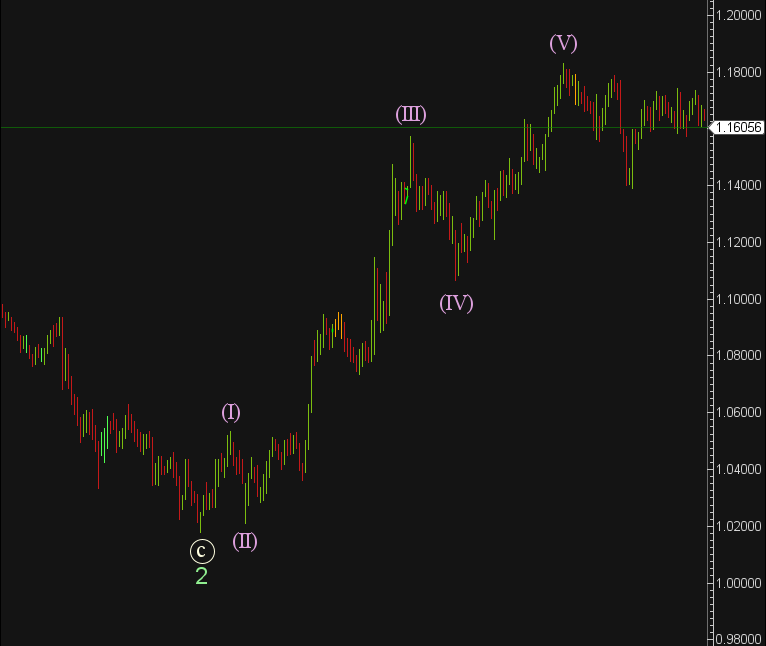
At the core of our strategy is the Elliott Wave Principle – a technical analysis framework that views market trends as a series of recurring wave patterns. Decades of market study have shown that price movements tend to form predictable 5-wave patterns in the direction of the trend (impulse waves), followed by 3-wave patterns against the trend (corrective waves). In simple terms, markets move in waves of optimism and pessimism, which create recognizable structures on the charts. By identifying these structures, we inject strategy and context into each signal.
Figure: A classic 5-wave impulse pattern in an uptrend. Waves 1, 3, and 5 (motive waves) drive the trend upward, while waves 2 and 4 are pullback corrections. Elliott Wave theory holds that such five-wave sequences signal a strong prevailing trend.
The figure above illustrates a 5-wave impulse. Why does this matter for a forex signal? Because if, say, EUR/USD is mapping out an impulse wave to the upside, we have a structured reason to look for buy opportunities (the trend is up). We know where we are in the pattern – for example, entering on a wave 2 or wave 4 pullback can position us to catch the powerful wave 3 or wave 5 advance. Each wave in the pattern has characteristic behavior and Fibonacci relationships, which helps in setting logical entry and exit points. Instead of a vague “it looks like it might go up,” we have a defined setup: “Price appears to be in Wave 2 of a new impulse – a correction – so we anticipate an upcoming Wave 3 rally. We’ll signal a long entry near the end of Wave 2, with a stop just below its low (invalidating the pattern if broken), aiming to ride the Wave 3.” This is a structured playbook drawn from a time-tested principle, not a guess.
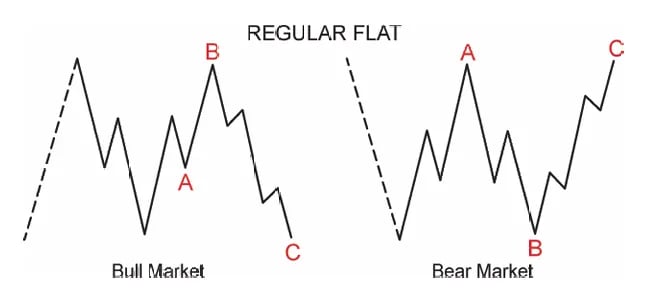
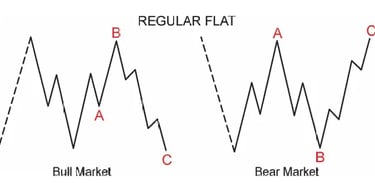
Importantly, our methodology covers both trending and corrective phases. Not every market move is a trendy impulse; sometimes price is choppy, forming a consolidation or reversal pattern. Elliott Wave analysis equips us to recognize those too – be it an ABC zigzag, an expanded flat, or a contracting triangle. These patterns have specific structures (for example, flats subdivide into a 3-3-5 sequence, triangles into 3-3-3-3-3 sub-waves labeled A-B-C-D-E) and we use that knowledge to avoid false signals. If a pair is stuck in a sideways triangle, we likely wait for the breakout rather than force a trade in the noise. If it’s a flat correction, we anticipate the range endpoints. This structured pattern recognition is our first layer of risk management – it keeps us from trading when the market has no clear structure or edge.
Figure: An example of a flat correction (A-B-C pattern). Flats are a common Elliott Wave corrective pattern where the market moves sideways/up and down in a range before the trend resumes. Knowing the pattern helps anticipate the breakout direction and key price levels.
By basing signals on Elliott Wave patterns, we ensure every trade has a rationale grounded in market psychology and structure. Subscribers also benefit by learning these patterns over time – instead of just “signal says buy XAU/USD,” you’ll start recognizing “aha, this looks like that 5-wave pattern or ABC pullback they mentioned.” It’s a more transparent and educational approach, building your skill as a trader rather than keeping you in the dark.
Multiple Timeframe Validation
Identifying a wave pattern on one chart is good, but confirming it across multiple timeframes is even better. Our analysis always goes through a top-down, multi-timeframe process. Why? Market waves are fractal – they repeat on different scales. A small 5-minute chart impulse might just be part of a larger hourly corrective wave, which itself sits inside a daily uptrend. To avoid flawed signals, we validate that the bigger picture aligns with the setup. For example, if the daily trend and weekly wave count indicate an uptrend, and we spot a bullish 5-wave impulse forming on the 1-hour chart, that’s a high-confidence confluence. Conversely, if a short-term pattern suggests a long trade but the higher timeframe shows a looming downtrend resistance, we’ll be cautious or pass on the trade – the odds are lower.
Practically, this means before any signal is sent, we check at least two or three timeframes. The larger timeframe (like daily or 4H) gives us the primary trend and major wave count. The smaller timeframe (like 1H or 15m) is where we fine-tune the entry – the smaller waves that trigger the trade. Multiple timeframe analysis filters out a lot of noise and false signals. It’s a discipline that many beginner traders skip, but it’s vital. In fact, a key Elliott Wave guideline is to start your analysis on higher timeframes first (e.g. weekly, then daily) before zooming in. This reduces the chance of misidentifying a pattern or trading a minor counter-trend move by mistake. We adhere to this rigorously. Our subscribers will often see notes like “the 4-hour chart shows we’re in wave 5 of a larger uptrend, so on the 15-minute chart we’re waiting for a final push to complete wave 5 and then a possible reversal” – thus aligning the timeframes. This context gives you confidence that a signal isn’t just popping out of thin air; it’s part of a broader market narrative.
Moreover, multi-timeframe checks help with timing. You might get the direction right but timing wrong if you only look at one scale. By drilling down to the precise wave on a lower timeframe, we aim to pinpoint entries more accurately (for example, catching the exact end of a small wave 2 pullback within a larger wave 3 advance). The result is signals that are patient and timely, not chasing late after a move is obvious.
Position Sizing Built into Signals
Another unique aspect of our methodology is position sizing guidance on every trade. We recognize that what you trade is only half the equation – how much you risk is equally crucial. Many traders fail not because their analysis is always wrong, but because their trade size is too large when they’re wrong. As one trading adage goes, "It’s not trading that kills accounts; it’s position sizing." In fact, errors in position sizing (risking too much) are a leading cause of account blowouts.
To ensure risk is controlled and consistent across all accounts, the Signal Service uses a clear lot sizing framework rather than per-trade risk instructions. Position size is determined solely by account balance, allowing every trader — regardless of account size — to take proportional exposure on each setup. Subscribers are guided to use the lot sizing guide pinned inside the Signal Service Telegram channel, which outlines the appropriate lot size for different account balances. This ensures risk remains stable and disciplined across all trades, without increasing exposure based on confidence or market conditions.
A strong setup does not mean increasing position size. Risk remains consistent by keeping lot size fixed relative to account equity, allowing probability and trade management to play out over time. This approach helps smooth the equity curve, reduces emotional decision-making, and prevents overexposure during periods of market volatility. By standardising position size rather than adjusting risk on individual trades, the Signal Service ensures that every trader — from small accounts to larger portfolios — follows the same professional risk framework used to manage trades responsibly
Additionally, by sizing positions so that each losing trade only dents your account by a fixed small amount, we make sure no single bad call can ever cripple you. Even the best strategies will have losing streaks. Our methodology plans for that by capping loss per trade and limiting consecutive losses impact. For instance, if we hit 5 losing signals in a row (it happens!), at 1% risk each you’d be down ~5% – not fun, but far from catastrophic. You live to fight another day. Contrast that with a trader risking, say, 5-10% on a single signal – just two losers could draw down 10-20%, which is very hard to stomach or recover from.
In summary, our Elliott Wave-based approach gives structure and strategy to each signal, multi-timeframe analysis vets the signal against the bigger picture, and built-in position sizing keeps your risk tightly controlled. It’s a disciplined, long-term approach to forex signals. In the next section, we’ll dive deeper into the risk management philosophy that underpins everything we do.
Risk Management Philosophy – Preserving Capital Above All
If there’s one thing that separates our forex signal service (and professional trading in general) from the get-rich-quick schemes out there, it’s this: Risk management comes first. Every aspect of our service is grounded in the belief that protecting your trading capital is the foundation for success. After all, if you don’t survive in the market, you can’t thrive. Let’s unpack how we implement risk management and how you, as a trader, benefit from this philosophy.
Fixed-Risk Models and Position Sizing
Rather than adjusting risk on a trade-by-trade basis, the Signal Service uses a standardised lot sizing framework designed to keep risk consistent across all market conditions. Position size is determined by account balance, not by confidence level, market volatility, or perceived trade quality.
This approach reflects a core principle of professional trading: risk consistency matters more than conviction. Every trade is taken with the same proportional exposure, ensuring that no single position can disproportionately impact account equity. Losing streaks become manageable, and emotional decision-making around “betting bigger” is removed entirely.
Subscribers follow the lot sizing guide pinned inside the Signal Service Telegram channel, which outlines the appropriate lot size for different account balances. This ensures that traders with small and large accounts alike are exposed to the market in a controlled, proportional manner, without the need to calculate risk manually for each trade.
Because trades are actively managed in real time, outcomes are determined by evolving market structure rather than mechanical stop-loss or take-profit levels. Risk is controlled through position size and live trade management, not static parameters.
This consistency is what allows accounts to withstand inevitable drawdowns and continue operating through changing market phases. By keeping position size fixed relative to equity, traders avoid large equity swings, maintain psychological stability, and allow probability to work over a series of trades — not just one.
Trading is not about forcing results on individual setups. It’s about staying solvent, disciplined, and objective long enough for edge and experience to compound over time.
Capital Preservation and Drawdown Control
Our number one priority is capital preservation. We echo the professional trader’s creed: focus on how much you can lose, before considering how much you can win. By limiting risk each trade, we aim to keep any drawdowns (a decline in account from peak) small and controlled. This isn’t just lip service – it’s mathematically crucial. Smaller losses are exponentially easier to recover from. A 5% drawdown only needs about a 5.3% gain to recover, while a 50% drawdown needs a whopping 100% gain to get back to even. By avoiding large losses, we protect you from falling into that hole. As FXStreet notes, “Capital preservation ensures that drawdowns remain manageable… professionals treat preservation as a primary objective, not an afterthought.”.
In practical terms, this means we always use invalidation levels to cap any single trade’s downside. Every signal has a clear invalidation point – often derived from the Elliott Wave pattern (e.g. “if price breaks this level, the wave count is invalid, so we exit”). We do not widen stops or remove them hoping a loss turns around. If a stop is hit, that trade is done – we take the loss and move on. This discipline keeps losses predefined and prevents a bad trade from snowballing. Additionally, we recommend setting daily or weekly loss limits for yourself (e.g. if you lose 3 trades or 3% in a day, stop trading and review). This aligns with our philosophy that survival is the edge that enables everything else – by surviving tough days intact, you remain available to capitalize when conditions improve.
Another aspect of capital preservation is knowing when not to trade. Sometimes sitting out is the best risk management. If our analysis finds no high-probability setup or the market is exceptionally volatile (e.g. during a major news event) and unpredictable, we may choose not to issue signals. No trade is better than a bad trade. Our long-term members appreciate that we don’t force trades to appear “active.” As the saying goes, cash (or no position) is also a position. Patience protects your capital during uncertain times so that it’s intact for high-confidence opportunities.
Start Your Journey – Try Our Signal Service Risk-Free
We’ve covered a lot: what forex signals are, why so many fail, and how our unique Elliott Wave-based, risk-focused methodology stands apart by providing structure and discipline. But we know that seeing is believing. The best way to appreciate a professional, risk-managed signal service is to experience it firsthand. That’s why we invite you to take our forex signals for a test drive with a free trial – no commitment, just an opportunity to see how it works for you.
During your free trial, you’ll receive our live signals in real time, complete with the analysis notes and risk guidance we’ve described. Watch how we map out the wave patterns, how we set stops and targets, and how we communicate the rationale for each trade. You can even paper-trade the signals or use a demo account to gauge performance without risking real money. The goal of the trial is not only to catch some good trades potentially, but also to demonstrate our transparent approach.
We’re confident that after a trial period, you’ll feel the difference compared to hype-driven services. Our trades won’t be the flashiest or the most frequent, but they will be methodical, well-thought-out and grounded in a long-term strategy. Whether you’re a beginner looking to learn or an intermediate trader seeking consistency, our service is designed to instil good trading habits while aiming for profitable signals.
Ready to get started? Take the next step in your trading journey by signing up for the free trial. There’s no better way to see the value of a risk-first, Elliott Wave-driven system than to witness it in action. We look forward to sharing our signals with you and helping you trade forex with greater confidence, structure, and peace of mind.
Disclaimer: Forex trading involves risk, and no signal or strategy can guarantee profits. Always trade with money you can afford to lose and consider your own financial situation and risk tolerance. Our service is about stacking the odds in your favor through analysis and risk management, but losses will happen. By using our signals, you agree to manage your own positions responsibly.
To learn more, see our Faq for common questions.
Explore more articles on our main blog page.
Disclaimer:
Trading forex involves significant risk and may not be suitable for all investors. Past performance is not indicative of future results. The information and signals provided on this website are for educational purposes only and should not be considered financial advice. You are solely responsible for your trading decisions and any resulting financial losses. Please consult with a licensed financial advisor before engaging in forex trading.
© 2026. All rights reserved.